-
July 16, 2026
Operational Excellence: How BPM Drives Continuous Improvement
Learn more

BPM vs workflow automation: Understand the difference with side-by-side comparison, decision criteria, use case examples, myth busting, and combined approach guidance. Learn when to use workflow automation, when to use BPM, and how they work together.

"BPM" and "workflow automation" are often used interchangeably. Marketing materials blur the terms. Vendors claim their workflow tool is actually BPM, or their BPM platform includes workflow automation.
The confusion is understandable. Both involve automating work. Both reduce manual effort. Both improve efficiency.
But they're not the same thing. Understanding the difference matters because choosing the wrong approach—or failing to combine them properly—leads to automation that doesn't deliver expected value.
This guide explains what each term actually means, when to use which approach, and how they work together in practice.
Workflow automation is the execution of predefined task sequences based on rules and triggers. When Event A happens, Task B executes automatically, followed by Task C.
Simple example: Expense claim workflow
The workflow automates the routing and notifications. No one manually forwards emails or tracks who needs to approve what.
Key characteristics of workflow automation:
Workflow automation excels at eliminating manual handoffs, ensuring work moves from person to person or system to system without delays or errors.
Business Process Management is a holistic approach to improving how work gets done across an entire organisation. BPM encompasses strategy, analysis, design, implementation, monitoring, and continuous improvement of business processes.
BPM is not just software. It's a discipline. A methodology. A way of thinking about work.
The BPM lifecycle:
Workflow automation is one tool within BPM. But BPM includes much more: process strategy, stakeholder management, change management, performance measurement, and organisational alignment.
Business Process Management is how organisations ensure work happens efficiently, consistently, and transparently—with workflow automation as a key enabling technology.
The clearest way to understand the difference is through direct comparison:
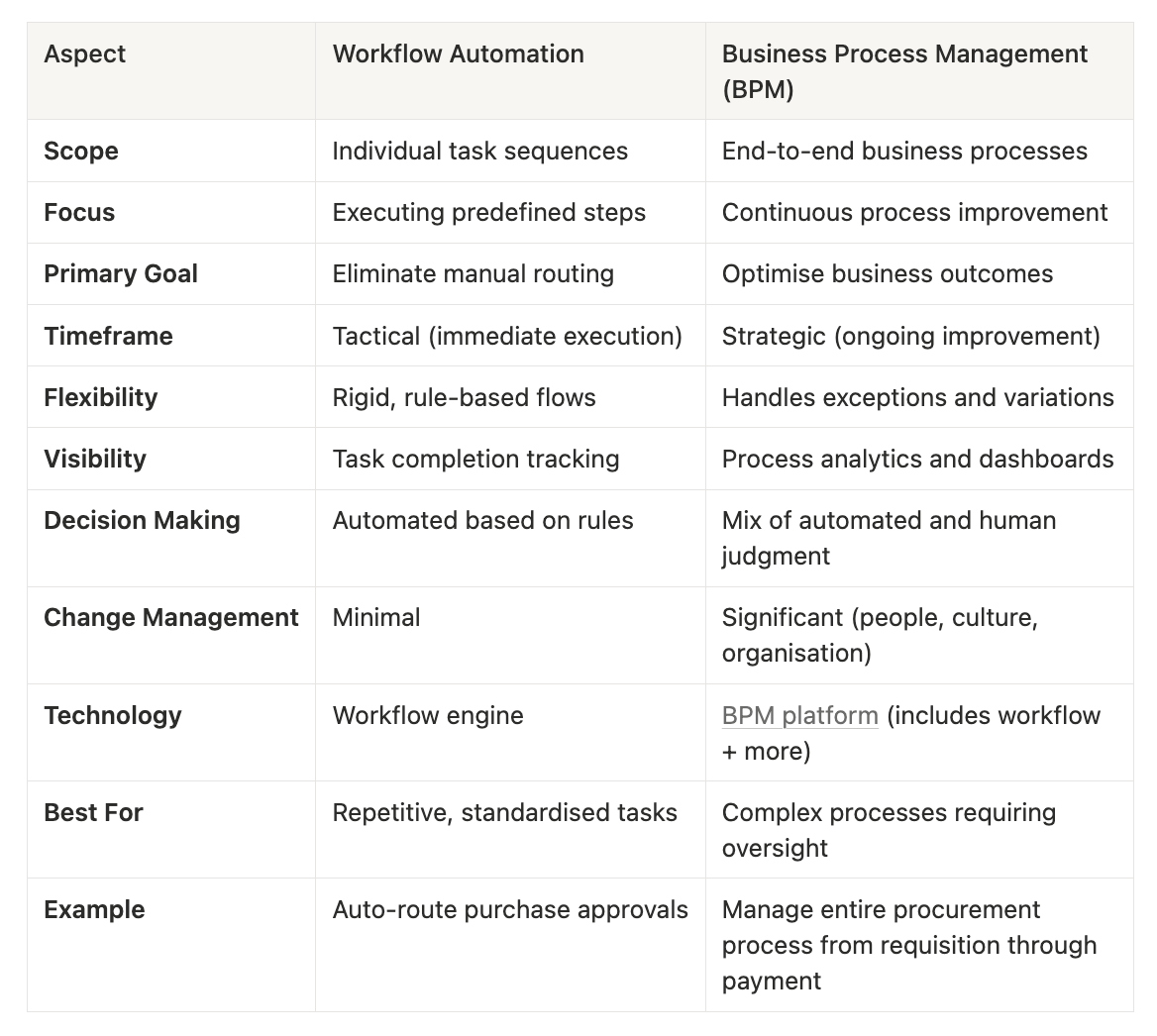
The key insight: Workflow automation is a component of BPM. BPM uses workflow automation as one tool among many to improve processes.
Workflow automation makes sense when you have:
Clear, linear sequences: Work follows predictable steps. A leads to B leads to C. No complex branching or exceptions.
Example: Employee leave requests
High volume, low complexity: Many cases flowing through the same simple process. Automation eliminates repetitive manual work.
Example: IT helpdesk ticket routing
Clear rules: Decisions can be codified. "If amount > £1,000, require finance approval."
Standalone tasks: The workflow doesn't require deep integration with broader process strategy or continuous improvement.
Speed is the priority: You need to deploy quickly. Workflow automation can often be implemented in days or weeks.
BPM is appropriate when you need:
End-to-end process visibility: You need to see and manage the entire process from start to finish, not just individual task sequences.
Example: Customer onboarding in financial services
Complex processes with exceptions: Standard workflows handle 80% of cases, but the other 20% require human judgment, escalations, or non-standard paths.
Cross-functional processes: Work spans multiple departments, systems, and stakeholders. You need orchestration and coordination.
Continuous improvement: Process performance matters strategically. You need to measure, analyse, and optimise based on data.
Regulatory and compliance requirements: You need comprehensive audit trails, approvals, and documentation. Workflow automation alone doesn't provide sufficient governance.
Long-term transformation: You're not just automating existing work—you're fundamentally improving how work gets done.

The most effective approach isn't choosing one or the other—it's using both together.
How they work together:
BPM provides the strategic framework:
**Workflow automation provides tactical execution**:
Real-world example: Purchase order approval process
BPM layer:
Workflow automation layer:
The workflow handles execution. BPM ensures the process itself is well-designed, measured, and continuously improved.
Myth 1: "Workflow automation is just simple BPM"
Reality: Workflow automation is a component of BPM, not a simplified version. BPM includes strategy, analysis, measurement, and improvement—none of which are part of pure workflow automation.
Myth 2: "BPM is too complex for small organisations"
Reality: BPM principles apply at any scale. A small business mapping, measuring, and improving its order fulfilment process is doing BPM. It doesn't require enterprise software or consultants.
Myth 3: "You need to choose either workflow automation OR BPM"
Reality: They work together. Most organisations need both. Use BPM thinking to design good processes, then implement with workflow automation.
Myth 4: "Workflow automation tools can't handle complex processes"
Reality: Modern workflow automation has advanced significantly. Many workflow tools include case management, exception handling, and analytics. The line between "workflow tool" and "BPM platform" is blurring.
Myth 5: "BPM is only about technology"
Reality: BPM is primarily about people, processes, and strategy. Technology enables BPM but doesn't define it.
Use this framework to determine the right approach:
Question 1: Is your primary goal to eliminate manual task routing?
Question 2: Do you need to optimise the entire process, not just automate existing steps?
Question 3: Does the process span multiple departments or systems?
Question 4: Do you need ongoing performance measurement and improvement?
Question 5: Are there significant exceptions or variations in how work gets done?
General guidance:

Both workflow automation and BPM require integration with your existing technology landscape.
Common integration points:
Workflow automation integration: Typically simpler, focused on triggering actions and passing data between systems.
BPM integration: More comprehensive, often requiring bidirectional data flows, real-time synchronisation, and complex orchestration across multiple systems.
Technology consideration: Choose a platform that supports your integration requirements, whether you're focused primarily on workflow automation or broader BPM.

Scenario 1: Simple approval workflow
Situation: HR needs to automate employee leave requests.
Right approach: Workflow automation
Implementation: Build simple approval workflow. Deploy in 1-2 weeks.
Scenario 2: Complex procurement transformation
Situation: Organisation wants to reduce procurement costs and cycle times.
Right approach: BPM
Implementation:
Timeline: 1-2 months for full implementation.
Scenario 3: Customer complaint resolution
Situation: Support team handles varied customer complaints requiring flexible case management.
Right approach: BPM with case management
Implementation: BPM platform with strong case management capabilities. Workflow automation handles standard routing, but case management handles exceptions and variations.
Workflow automation and BPM aren't competing approaches. They're complementary.
Workflow automation is a powerful tool for eliminating manual task routing, enforcing business rules, and connecting systems. It's tactical, focused, and delivers quick wins.
BPM is a strategic discipline for improving how work gets done across your entire organisation. It includes workflow automation but adds process design, analysis, measurement, and continuous improvement.
The winning combination: Use BPM thinking to design excellent processes, then implement them with workflow automation technology.
Don't get hung up on terminology. Focus on outcomes:
Choose based on your needs, not vendor marketing. Understand what you're trying to achieve, then select the approach and technology that fits.
Insights on process automation, product updates, and what's happening at Emakin
Süreç yönetimi, ürün geliştirmeleri ve Emakin'deki güncel gelişmeler

Emakin is a low-code platform that helps businesses quickly design, automate, and manage their business processes effortlessly.





Emakin, kurumların iş süreçlerini daha hızlı, kontrollü ve verimli şekilde yönetmesine olanak tanıyan bir low-code BPM platformudur.